————————————————————————————
Report (100pts)
Theory, Procedure, Data, Analysis, and conclusion
THEORY (10pts):
Briefly explain the underlying physical principle and exactly what you want to test.
PROCEDURE (30pts):
Explain what you did, at a level such that someone in your class could reasonably reproduce your results. Include at least one diagram.
DATA (20pts):
Include data tables (can be LaTeX’d, word doc’d, excel’d, pictures of hand-drawn tables, etc – as long as they’re legible, we’re happy). Explain the meaning of any variable you introduce. Include uncertainties. (Note that having poor data and explaining what went wrong is much, much, much
better than fudging your data. One is a reasonable thing to do, and the other is academic dishonesty.)
ANALYSIS (20pts):
Explain how you got from your data to your result. No need to show every step of your derivations, but give enough explanation that a classmate could reproduce your results.
CONCLUSION (20pts):
What did you find? Numbers should include uncertainties. What went wrong? What might have affected your results (sources of error)? How could the experiment be improved?
————————————————————————————————
——————————————————————————–
Abstract:
Force and motion is a universal concept that applies to all matter in the universe. Motion is the changing of position or location which requires a force to cause that change. Forces influence objects that are at rest or that are already in motion. In the three laws of motion proposed by Isaac Newton, it involves the notion of inertia, mass, velocity, and momentum. These laws and factors contribute to the driving force that helps apply the concept of force and motion that we experience everyday. Using the online simulation provided by the Phet website, we will be conducting experiments involving force and motion.
Introduction:
In lecture as well as additional readings from our textbook, we have been introduced to the different aspects and rules that apply to the world of physics. There are three important notions that Isaac Newton proposed when he first studied and introduced the motion of objects. He stated that (1) a stationary object will remain stationary unless an external force acts on it, (2) the change in an object’s motion is proportional to the force acting on it, and (3) every force has an equal and opposite force.
By using the online simulation, we aim to demonstrate the concept of force and motion with the provided resource. The simulation should be able to provide results that would mimic the experiment if we were to do it in person. The data and calculations taken from the experiment will be able to showcase the theory behind force and motion and give us a better understanding behind it. With both concepts, we will learn all the factors that play a part in force and motion and it will give us a deeper understanding behind what is needed to put something into motion as well as what type of force and how much force is needed to create that motion.
Theory:
With respect to Newton’s Second Law of Motion, we can understand the significance of the relation between force, mass, and acceleration. Under the circumstances of the experiment and in real life situations, force is simply a push or pull that acts upon an object. Furthermore, force is a vector quantity, in which it accounts for magnitude and direction. Newton’s Second Law regards the function of such objects for which all prevailing forces are not balanced.
As forces become unbalanced – another vector quantity – acceleration emerges. Acceleration directly depends on the net force which is the sum of all forces acting upon an object. As the net force increases, so does the acceleration. As the net forces decrease, so does the acceleration. On the other hand, acceleration inversely depends on an object’s mass in which the acceleration decreases as the mass increases. If the mass were to decrease, then acceleration would increase.
As Newton’s Second Law may be expressed verbally, it can also be explained mathematically. As force has direction we may find different forces along the experiment, the first equation will be used to find the net force:
FNet = F1 + F2 + F3+…
The second equation will be used to find the weight of such object:
Fw = mg
The magnitude of the weight is equivalent to the magnitude of the normal force, this can be expressed in the equation:
Fn = Fw
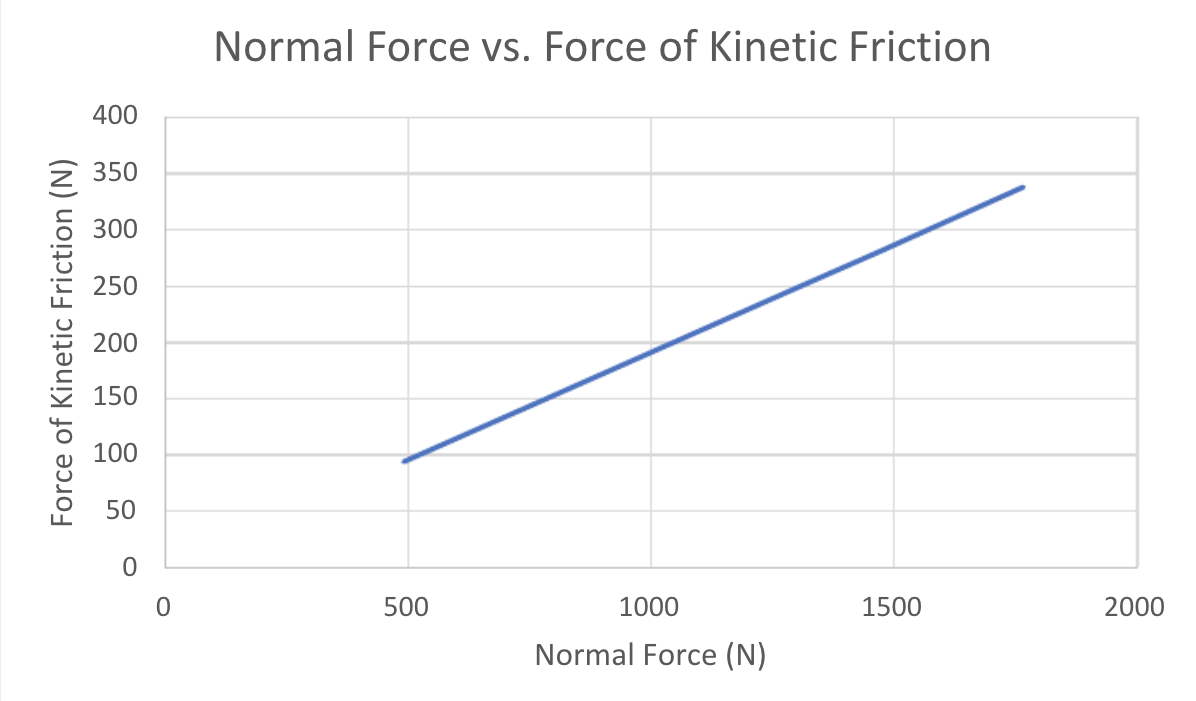
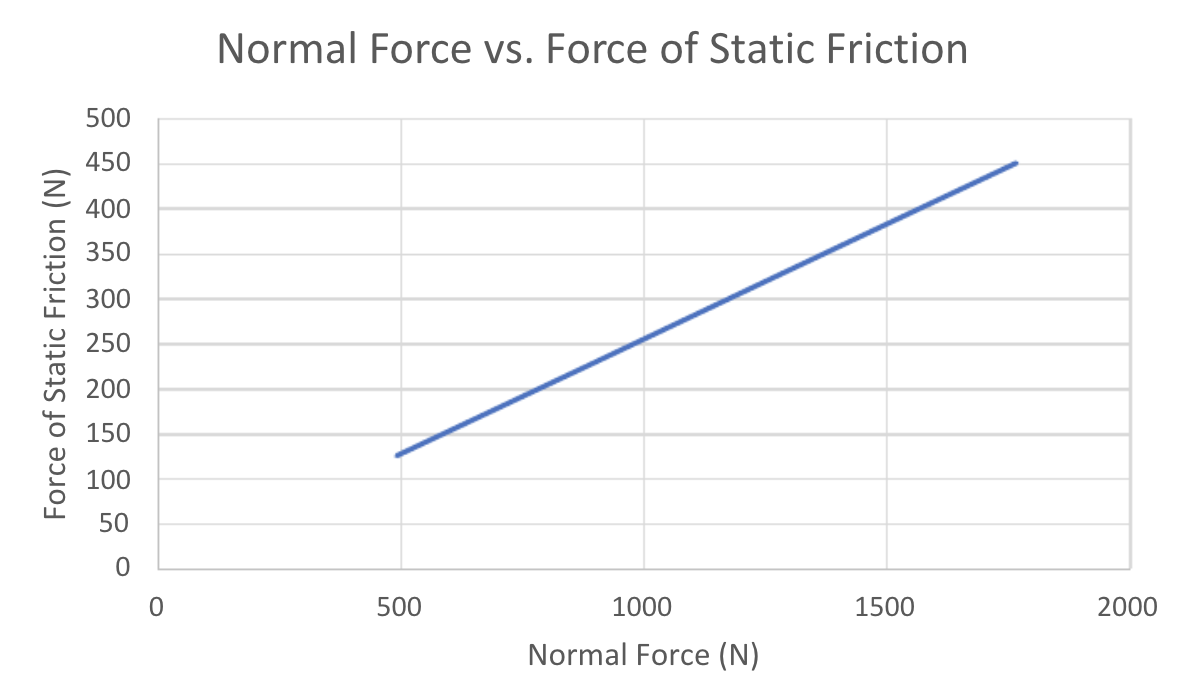
We will not only be calculating with equations but also graphs. We will be using google excel to make graphs and the slope in the graph will identify the coefficient of friction (μ). In the case of using the equation (shown below) we can find static and kinetic friction:
(Static Friction) Fs = μsN
(Kinetic Friction) Fk = μkN
Experimental Apparatus & Setup:
Due to unfortunate circumstances of the COVID19 pandemic, our experimental setup was affected. Providentially, we were able to continue with the help and efforts of the Phet Colorado website. For this project, our experimental apparatus and setup consist of a virtual simulation from the website mentioned. This virtual simulation allows us to experiment and collect data that pertains to forces and motion, hence, the title of the project. In addition, we used our knowledge from this course, while applying “Chapter 4: Forces and Newton’s Laws of Motion” and “Chapter 5: Applications of Newton’s Laws.” The equipment needed to perform the experiment is all provided in the simulation.
Within the simulation setup, there are four selections to choose from:
For all four selections of the simulations, we can insert various inputs to each simulation, such as a figure(s), a box, a trash bin, a gift box, a refrigerator, and a bucket of water, all providing different quantities in mass, speed, direction, and force.
Procedure:
Part 1
This part concludes Newton’s Second Law of Motion in which the concerning object will remain stationary unless external forces act on it. In this case, we add force to the right and left side of the cart to make it either move or remain stationary. We will find out how the forces affect the magnitude, the velocity, and the direction of the resultant force as well as the object (a cart).
Part 2
This part concludes Newton’s Second Law of Motion in which the change in an object’s motion is proportional to the force acting on it. In this case, we are introducing mass and applying a force to the object (crate on skateboard) so it will start moving. We will find out how mass affects the motion of the object as it will cause it to either decelerate or accelerate.
Part 3
This part concludes Newton’s Second Law of Motion in which an object’s motion is proportional to the force acting on it. In this case, frictional force will be a part of the net forces. It can also come to terms with how every force has an equal and opposite force. In this case, friction force may be equal to the applied force. We will find out if frictional force is strong enough to either keep the object (a crate) at rest or moving.
Part 4
This part concludes Newton’s Second Law of Motion in a similar way to all 3 parts above. We will be applying force and mass, as this experiment includes friction. We will find out how all these factors affect acceleration.
Data:
One equation that is needed is one to find the resultant forces:
F = F1 + F2 + F3 . . .
Another equation used was one to find the weight:
Fw = mg
Another equation we used was to find the magnitude of the normal force:
Fn = Fw
To find the slope we used:
m = y2 – y1 / x2 – x1
The formula we used to find the forces of static and kinetic friction are:
Fs = ????sN and Fk = ????kN
Mass (kg)
Weight (N)
Normal Force (N)
Force of Static Friction (N)
50
491
491
126
90
883
883
226
130
1275
1275
326
150
1472
1472
376
180
1766
1766
451
Mass (kg)
Weight (N)
Normal Force (N)
Force of Kinetic Friction (N)
50
491
491
94
90
883
883
169
130
1275
1275
244
150
1472
1472
281
180
1766
1766
338
Analysis: (Explain how we got the data)
Insert here
Conclusion:
In our lab experiment, there was definitely room for error. We used a website to conduct our experiment. Therefore, some of the things that may have gone wrong may occur due to technical, human, and instrumental error. An example of technical error would be how sometimes the object would move on its own without any force applied to it. A human error is not being able to read the results that we got or putting the right units. An instrumental source of error was that we could not see what speed our object was going. If this experiment was conducted in real life, an error would be how environmental factors such as the wind changes the direction or speed of the object.
In this experiment we explored the notions of Newton’s Second Law of Motion. The law formally states that acceleration occurs when a force acts on a mass and the greater amount of force on an object is needed when that mass of an object is greater. In our lab we conducted it into three parts; net force, motion, and friction. In terms of force, the experiment simply shows that if we move an object with force it will move. In terms of motion, the experiment explains with graphs, that if we put force over time the velocity would increase rapidly over the time. In terms of friction, the experiment illustrates in the graphs that friction increases when the object has motion; we can conclude that the opposing force is the friction force. Overall the results of the lab experiment exemplified the principles of Newton’s Second Law of Motion.
References
Phet Colorado simulation – Forces and Motion: Basics
https://phet.colorado.edu/sims/html/forces-and-motion-basics/latest/forces-and-motion-basics_en.html
https://www.physicsclassroom.com/class/newtlaws/Lesson-3/Newton-s-Second-Law


Delivering a high-quality product at a reasonable price is not enough anymore.
That’s why we have developed 5 beneficial guarantees that will make your experience with our service enjoyable, easy, and safe.
You have to be 100% sure of the quality of your product to give a money-back guarantee. This describes us perfectly. Make sure that this guarantee is totally transparent.
Read moreEach paper is composed from scratch, according to your instructions. It is then checked by our plagiarism-detection software. There is no gap where plagiarism could squeeze in.
Read moreThanks to our free revisions, there is no way for you to be unsatisfied. We will work on your paper until you are completely happy with the result.
Read moreYour email is safe, as we store it according to international data protection rules. Your bank details are secure, as we use only reliable payment systems.
Read moreBy sending us your money, you buy the service we provide. Check out our terms and conditions if you prefer business talks to be laid out in official language.
Read more